
- October 16, 2026

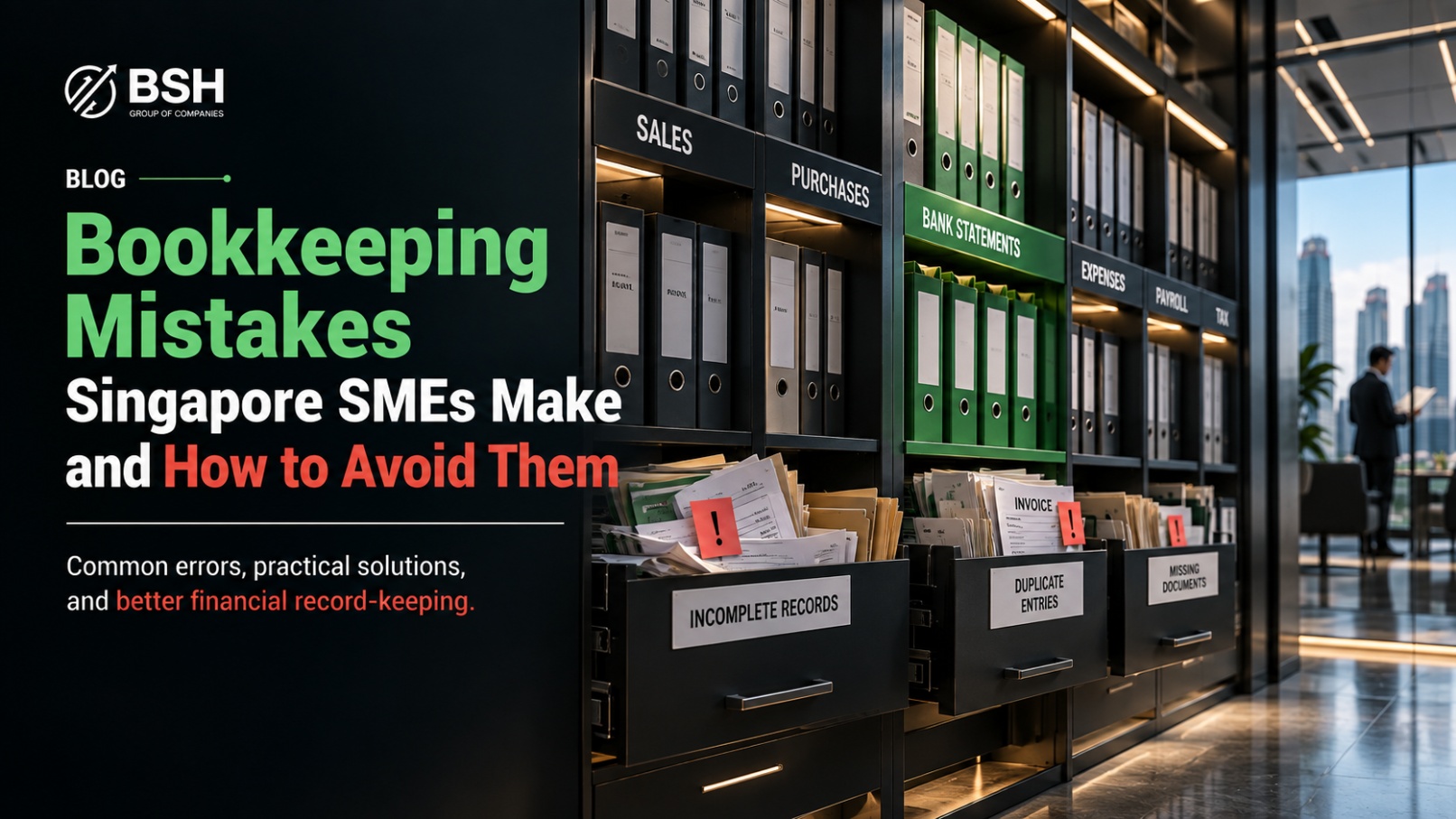
A director signs off the company’s annual return without ever seeing a reconciled bank statement. A founder pays office rent from a personal account because the corporate account isn’t open yet. A bookkeeper enters transactions once a quarter, right before the GST deadline. None of these feel urgent in the moment, but they’re three of the most common bookkeeping mistakes Singapore SMEs make, and each one carries a specific, checkable cost under Singapore law.
This isn’t a list of tidiness tips. IRAS can disallow expenses it cannot verify. Getting GST treatment wrong creates genuine liability, not just an awkward call with your accountant. And under the Companies Act, keeping proper accounting records is a director’s personal statutory duty. Here are the 10 mistakes that cause the most damage and exactly how to avoid each one.
What Bookkeeping Mistakes Actually Cost You
The most common bookkeeping mistakes Singapore SMEs make are mixing personal and business funds, entering transactions late, skipping bank reconciliation, misclassifying expenses and GST, losing source documents, confusing profit with cash flow, mishandling director’s drawings, over-relying on spreadsheets, and only reviewing the books once a year. Each one raises the risk of disallowed IRAS expense claims, GST errors, and personal exposure for directors under the Companies Act.
Most owners treat these as back-office problems a bookkeeper will eventually clean up. In practice, the consequences attach to specific people and specific deadlines. Below is exactly what goes wrong, and what to do instead.
10 Bookkeeping Mistakes Singapore SMEs Make (And How to Avoid Them)
- Mixing Personal and Business Money
This is usually the first mistake a new company makes, and it’s rarely deliberate. The corporate bank account isn’t open yet, so the founder covers a supplier invoice personally, or a director buys a laptop and means to claim it back later. Over a few months, the line between company money and personal money blurs completely, and if IRAS can’t tell whether a transaction was for the business or for you personally, the safer position for them is to disallow it.
How to avoid it:
- Open the corporate bank account before the company starts trading, and route every business transaction through it.
- Pay yourself through a formal, documented salary, not ad hoc withdrawals from the business account.
- If a director genuinely covers a business cost personally, record it as a loan to the company and reimburse it through the books, not in cash.
- Letting Bookkeeping Fall Behind
Quarterly bookkeeping, done the week before a GST return is due, is one of the most common patterns among growing SMEs. Three months of receipts and invoices lose their context fast, and reconstructing what a specific payment was for turns into a guessing exercise. Errors compound quietly for months before anyone notices, and the year-end close takes longer because your accountant is untangling backlog instead of reviewing clean figures.
How to avoid it:
- Set a fixed weekly or, at minimum, monthly cadence for entering transactions, and treat it as non-negotiable as payroll.
- Use cloud accounting software with a live bank feed so transactions appear close to real time rather than in a batch.
- Photograph or file every receipt at the point of purchase, since a missing document three weeks later is a missing document for good.
- Skipping Monthly Bank Reconciliation
Bank reconciliation means checking that every transaction in your accounting records matches an entry on your actual bank statement, and flagging anything that doesn’t. It’s mechanical, which is exactly why it’s the first thing to get skipped when a business is busy. Without it, duplicate entries, missed payments, and outright fraud can sit in the books for months. A profit and loss statement built on an unreconciled ledger looks precise while resting on numbers nobody has actually verified.
How to avoid it:
- Reconcile bank accounts monthly at a minimum, weekly if transaction volume is high.
- Investigate every unexplained variance the same month it appears, not at year-end.
- Use accounting software with automated bank matching, and review the exceptions it flags rather than every line.
- Misclassifying Transactions and Expenses
Recording a laptop purchase as a routine office expense instead of a fixed asset, or lumping rental income, disposal gains, and currency movements into one catch-all ‘other income’ line, skews your profit figure and your balance sheet. It also creates work later, since someone eventually has to go back and untangle what each entry actually was.
How to avoid it:
- Keep a clean, consistently applied chart of accounts, and train anyone entering data on how to use it.
- Label unusual or one-off entries clearly at the point of entry, not months later from memory.
- Review the chart of accounts periodically for accounts that have become a dumping ground for miscellaneous items.
- Getting GST Treatment Wrong
Singapore’s GST rate has stood at 9% since 1 January 2024, and businesses must register once taxable turnover exceeds SGD 1 million in a 12-month period (IRAS). SMEs regularly apply the standard rate to zero-rated exports, treat exempt supplies as though input tax can be claimed on them, or simply approach the registration threshold without tracking it. Each error changes the figures that ultimately go into your corporate tax filings and your GST return.
How to avoid it:
- Tag GST treatment (standard-rated, zero-rated, exempt) at the point of entry rather than guessing at filing time.
- Track taxable turnover on a rolling 12-month basis so GST registration is a planned event, not a surprise.
- Reconcile output and input tax against your GST return before filing, not after IRAS raises a query.
- Losing Receipts and Source Documents
Two separate obligations sit behind this mistake. IRAS requires companies to keep source documents, accounting records, and bank statements for at least 5 years from the relevant Year of Assessment, and non-compliance is treated as an offence under the Income Tax Act (IRAS). Separately, Section 199 of the Companies Act places a personal statutory duty on directors to ensure the company keeps accounting records sufficient to explain its transactions and financial position. A breach is a criminal offence, and responsibility sits with the directors, not with whoever happened to be entering the invoices.
How to avoid it:
- Store receipts, invoices, and bank statements digitally from day one, organised by financial year.
- Retain records for a minimum of 5 years, and longer if a transaction, dispute, or loan is still open.
- If the company is ever struck off, someone who was an officer immediately before dissolution remains responsible for keeping the records for a further 5 years.
- Confusing Profit With Cash Flow
A profit and loss statement can show a healthy margin while the bank account is nearly empty, because profit is recorded when it’s earned, not when cash actually lands. Late-paying customers, upfront supplier payments, and seasonal sales all create timing gaps that a P&L alone won’t show. SMEs that only look at profit often get blindsided by a cash shortage they had no visibility into.
How to avoid it:
- Maintain a rolling cash flow forecast alongside your P&L, not instead of it.
- Track accounts receivable ageing and follow up on overdue invoices as a routine task, not an afterthought.
- Review your cash position weekly during periods of fast growth or seasonal swings, when the gap between profit and cash widens fastest.
- Mishandling Director’s Drawings and Payroll
Treating an owner’s withdrawal as a business expense, rather than a drawing or a properly recorded salary, distorts your profit figures and creates a shareholder loan account nobody is tracking. On the payroll side, inconsistent CPF calculations or missed statutory deductions create disputes with employees and compliance exposure with CPF Board.
How to avoid it:
- Pay directors and working shareholders through a formal, documented salary or dividend, not informal withdrawals.
- Record any genuine drawing against a loan or equity account, never as an operating expense.
- Run payroll and CPF calculations through consistent software or a provider, rather than recalculating manually each month.
- Relying on Spreadsheets Instead of Proper Accounting Software
A spreadsheet works fine for the first few months. Past a certain transaction volume, it becomes a liability: no audit trail of who changed what, no bank feed to catch discrepancies automatically, and version-control chaos when more than one person is entering data. Many SMEs keep using spreadsheets well past the point they’ve outgrown them, simply because switching feels like a project nobody has time for.
How to avoid it:
- Move to cloud accounting software once transaction volume or team size makes manual entry error-prone.
- Choose software with a live bank feed and a locked audit trail, so every entry is traceable.
- Migrate historical data properly rather than starting a new system with only current-year figures, so year-on-year comparisons still work.
- Not Reviewing the Books Until Year-End
Every mistake above compounds into the same moment: the point where someone has to turn twelve months of books into a set of financial statements. A compilation report or set of unaudited financial statements can only be as accurate as the records behind it. Gaps don’t disappear at year-end; they surface as extra hours spent tracing, correcting, and re-querying, which shows up directly in how long it takes to prepare accurate year-end financial statements and what that preparation costs.
How to avoid it:
- Review a simple monthly profit and loss statement and balance sheet, not just once a year at close.
- Reconcile management figures against the bank and GST filings quarterly, so nothing is a surprise at year-end.
- Flag unusual balances or unexplained entries the month they appear, not during the year-end scramble.
Building a Bookkeeping System That Doesn't Break Down
Individually, none of these 10 mistakes look catastrophic. Together, they describe a business that finds out how it’s actually performing several months after the fact, from records nobody would want to defend under scrutiny. The fix isn’t a single tool or a single hire. It’s a consistent cadence: transactions entered close to real time, accounts reconciled monthly, GST tagged correctly at the point of entry, and documents retained the way the law requires.
What This Looks Like in Practice
“The books that cause the most trouble at compilation and audit stage are almost never wrong because of one big error. They’re wrong because of a handful of small habits nobody corrected early: a personal card here, a missed reconciliation there. By the time it reaches us at year-end, untangling months of that costs far more than fixing the habit would have.”
— M. Rahman, Audit and Tax Manager, BSH Group
When to Bring In Professional Bookkeeping Support
Not every SME needs to outsource bookkeeping from day one, but there’s a point where DIY records cost more in time and risk than handing them over. If reconciliation is consistently skipped, GST filings take days of back-and-forth, or your turnover is approaching the SGD 1 million registration threshold, that’s the signal. Hands-on bookkeeping support in Singapore covers monthly entry, reconciliation, and GST classification, done consistently enough that year-end becomes a review rather than a reconstruction project.
Conclusion
Bookkeeping mistakes rarely announce themselves. They show up months later as a disallowed expense, a GST query, or a year-end close that takes twice as long and costs more than it should.
- Separate business and personal money from day one, and record everything through the corporate account.
- Enter transactions and reconcile the bank account on a fixed monthly cadence, not in a pre-deadline scramble.
- Keep GST classification correct at the point of entry, and retain source documents for the full 5-year period IRAS requires.
If any of the 10 mistakes above sound familiar, the cheapest time to fix them is now, not at your next filing deadline. Get in touch for a free consultation and BSH Group’s team will walk through where these bookkeeping mistakes are showing up in your own books, and what it would take to close the gaps.


Not Sure Where Your Books Currently Stand?
BSH Group can review your current bookkeeping setup, flag the gaps that would cause problems at tax filing or year-end, and take the monthly upkeep off your hands.
Frequently Asked Questions
What are the most common bookkeeping mistakes Singapore SMEs make?
The most common bookkeeping mistakes Singapore SMEs make include mixing personal and business funds, entering transactions late, skipping monthly bank reconciliation, misclassifying expenses, getting GST treatment wrong, losing source documents, confusing profit with cash flow, mishandling director’s drawings, relying on spreadsheets instead of proper software, and not reviewing the books until year-end.
How long must a Singapore company keep its accounting records?
IRAS requires companies to keep proper source documents, accounting records, and bank statements for at least 5 years from the relevant Year of Assessment. GST-registered businesses must retain GST-related records for the same 5-year period. Under Section 199 of the Companies Act, directors carry a separate statutory duty to ensure these records are kept and are open to inspection.
What happens if IRAS finds unsupported or disallowed expenses in my books?
If a business cannot produce proper records to support a transaction, IRAS may disallow the related expense claim, use its own estimate of revenue earned instead of the figures submitted, and impose penalties. This can increase the company’s taxable income and its final tax bill, on top of any penalty charged.
Can messy bookkeeping affect my company's audit exemption or compilation report?
Yes. A compilation report or set of unaudited financial statements can only be as accurate as the underlying books. Unreconciled accounts, missing documentation, or misclassified transactions extend the time and cost needed to prepare year-end financial statements, and can raise questions during a bank or investor review even where a full audit isn’t required.
When should an SME move from DIY bookkeeping to professional bookkeeping services in Singapore?
A reasonable trigger point is when monthly reconciliation is consistently skipped, GST filings take days of back-and-forth to sort out, or the business has crossed or is approaching the SGD 1 million GST registration threshold. At that stage, professional bookkeeping services in Singapore typically cost less in time and risk than continuing to patch together DIY records.
Categories
Latest Posts
- September 29, 2026
How to Register a Company in Singapore Without Relocating: A
- September 20, 2026