
- October 16, 2026

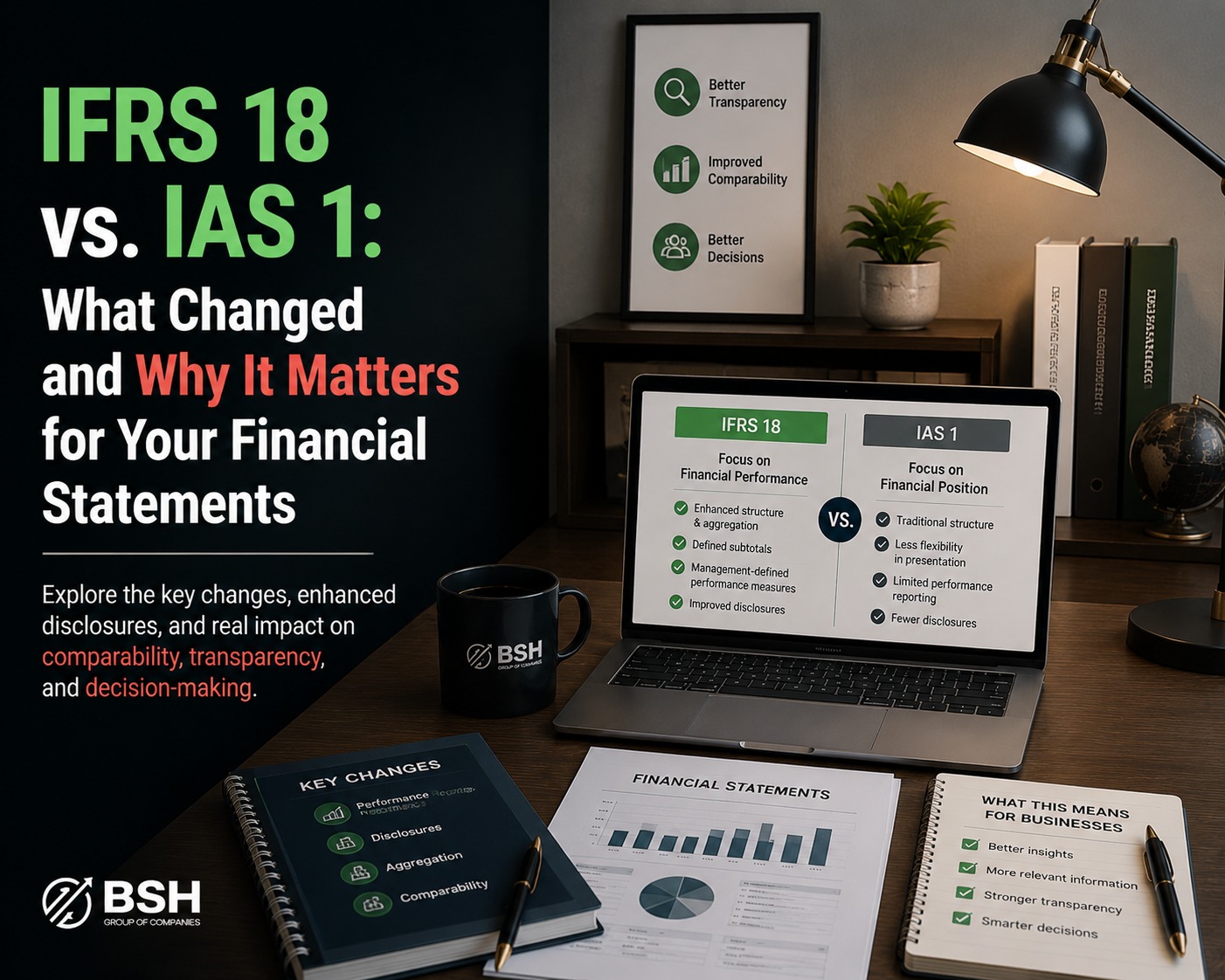
In April 2024, the IASB replaced IAS 1 with IFRS 18 — the most significant overhaul of financial statement presentation in nearly three decades. Effective 1 January 2027 with retrospective application, IFRS 18 changes how income and expenses are classified, introduces mandatory subtotals that never existed before, and brings management-defined performance measures into the audited financial statements for the first time. If your company prepares SFRS-compliant accounts, this affects you. This guide explains what changed, why it matters, and what you need to do before 2027.
TABLE OF CONTENTS
- 1. Why IAS 1 Was Replaced
- 2. What IFRS 18 Actually Changes
- 3. The Five Income and Expense Categories
- 4. The Two New Mandatory Subtotals
- 5. Management-Defined Performance Measures (MPMs)
- 6. Changes to Expense Analysis
- 7. IAS 1 vs. IFRS 18: Side-by-Side Comparison
- 8. The Real Pain Points: What Will Be Hard
- 9. What Stays the Same
- 10. Timeline and What to Do Now
- 11. Frequently Asked Questions
Most changes to accounting standards are incremental. A new disclosure requirement here, a clarified definition there. IFRS 18 is not that. It is a structural redesign of how financial performance is communicated — and its effects will ripple through income statements, note disclosures, internal reporting systems, banking covenants, and investor communications alike.
For companies in Singapore that prepare financial statements in accordance with the Singapore Financial Reporting Standards (SFRS), which are aligned with IFRS, IFRS 18 will apply. That means the 2027 deadline is not a distant concern — it is a preparation problem that starts now, because the standard requires retrospective restatement of 2026 comparative figures.
DEADLINE YOU CANNOT IGNORE
IFRS 18 is mandatory for annual reporting periods beginning on or after 1 January 2027. Because it requires full retrospective application, companies must restate their 2026 comparative figures in the new format. That means 2026 is effectively your first IFRS 18 year — whether you are ready or not.
Why IAS 1 Was Replaced
IAS 1 has governed financial statement presentation since 1997. For most of that time, it served its purpose. But three structural problems accumulated over the decades that investors, analysts, and regulators repeatedly flagged.
Problem 1: ‘Operating Profit’ Was Undefined
IAS 1 never defined what operating profit means. Companies could — and did — draw the line wherever suited them. One company might include gains on property disposals in operating profit. Another in the same industry would exclude them. Both were compliant. The result was that comparing operating performance between companies was often meaningless without first unpicking how each had constructed their income statement.
Problem 2: Non-GAAP Measures Were Unregulated
Companies increasingly used alternative performance measures — adjusted EBITDA, underlying earnings, core profit — in investor presentations, earnings calls, and press releases. These measures were not required to reconcile clearly to audited figures. Investors had to take management’s word for how they were calculated. Different companies defined the same metric differently. The information landscape became cluttered with numbers that were difficult to verify and impossible to compare.
Problem 3: Income Statement Flexibility Produced Incomparable Results
Under IAS 1, companies had broad discretion over how they structured their income statements. Items like foreign exchange gains, interest on lease liabilities, and income from equity investments could appear in different places depending on the company’s choices. A single line labelled ‘Other income’ could contain rental income, disposal gains, and currency movements — all mixed together with no obligation to separate them.
THE IASB'S CONCLUSION
After years of consultation with investors, analysts, and preparers, the IASB concluded that IAS 1’s flexibility had become a liability. IFRS 18 is the response: a structured framework that eliminates most of that discretion without eliminating judgment entirely.
What IFRS 18 Actually Changes
It is important to be precise about what IFRS 18 does and does not change. Recognition and measurement rules are unchanged. How you calculate revenue, measure assets, or account for leases is not affected. IFRS 18 is exclusively about presentation and disclosure — how financial information is organised, labelled, and communicated.
That scope sounds narrow. In practice, the effects are broad because presentation affects how every reader of your financial statements interprets your performance. When operating profit is redefined, your reported figures change even if the underlying transactions do not. When MPMs move into the audited notes, disclosures that were previously in investor presentations must now be reconciled to IFRS figures and reviewed by your auditor.
The four core changes are:
- A structured five-category classification for all income and expenses in the statement of profit or loss
- Two new mandatory subtotals — operating profit and profit before financing and income taxes
- New disclosure requirements for management-defined performance measures (MPMs)
- Required analysis of operating expenses on the face of the income statement, not just in the notes
The Five Income and Expense Categories
IFRS 18 requires all income and expenses to be classified into one of five defined categories. Three of these are new. Under IAS 1, there was no mandatory classification framework — items could appear in whatever grouping the entity chose.
| Category | What It Includes | Status Under IAS 1 |
|---|---|---|
|
1. Operating |
Income and expenses from the entity’s main business activities. The default category — anything not clearly in another category lands here. |
Existed, but undefined. ‘Operating profit’ had no standard definition. |
|
2. Investing |
Returns from assets held for investment purposes that are not integral to main business activities. E.g. dividends from non-strategic equity investments, interest on cash deposits. |
No separate category. Often mixed into ‘Other income’. |
|
3. Financing |
Cost of obtaining financing. Primarily interest expense on borrowings. Narrower than most companies currently treat it. |
Often self-defined. Scope varied widely between entities. |
|
4. Income taxes |
Tax expense or income under IAS 12, plus related foreign exchange differences on tax balances. |
Existed as a line item but not a defined category. |
|
5. Discontinued operations |
Results of operations classified as discontinued under IFRS 5. |
Existed under IFRS 5. Carried forward unchanged. |
The operating category is the most consequential. It is the default: if income or expense does not clearly belong to investing, financing, income taxes, or discontinued operations, it goes in operating. This is a significant shift for companies that have historically used ‘Other income’ or similar catch-all lines to group dissimilar items.
PRACTICAL IMPACT
A company that currently shows ‘Other income’ containing rental income from investment property, foreign exchange gains, and a gain on disposal of an equity investment will have to separate these under IFRS 18. Each belongs in a different category. The catch-all line disappears.
The Two New Mandatory Subtotals
IFRS 18 introduces two subtotals that must now appear on the face of every income statement. These are not optional.
Subtotal 1: Operating Profit or Loss
This is the sum of all income and expenses in the operating category. It is now a defined, mandatory line. Every company preparing IFRS-compliant accounts must present it.
Why this matters: under IAS 1, companies could present — or not present — an operating profit line wherever they chose. Many did. But the definition varied. Under IFRS 18, the definition is standardised. A company whose operating profit previously included returns from equity investments may find that those items now move to the investing category, changing the reported figure. Loan covenants tied to ‘operating profit’ may be affected. Internal KPIs that referenced it will need to be reviewed.
Subtotal 2: Profit Before Financing and Income Taxes
This is a new subtotal that sits between operating profit and profit before tax. It captures the result after including investing activities but before financing costs and taxes. Think of it as a formalised version of what analysts sometimes call EBIT — but defined by the standard, not by management.
Note: this subtotal is not required when an entity’s main business activity is providing financing to customers (e.g. banks, insurance companies) or when investing activities are the entity’s main business. For most operating businesses, however, it is mandatory.
WHY ANALYSTS WANTED THIS
The two new subtotals allow investors to evaluate operating performance independently of capital structure and tax effects — and to do so consistently across companies. Previously, analysts had to reconstruct these figures themselves, often with different methodologies. IFRS 18 standardises what they were already trying to calculate.
Management-Defined Performance Measures (MPMs)
This is arguably the most impactful change for companies that actively communicate with investors or lenders.
An MPM is any subtotal of income and expenses that management uses in public communications — press releases, investor presentations, annual reports, earnings calls — that is not already defined by IFRS. Adjusted EBITDA, adjusted operating profit, underlying earnings, normalised revenue — if management references these publicly and they involve adding back or excluding items from IFRS figures, they are MPMs.
Under IAS 1, these measures lived outside the audited financial statements. Management could define them however they chose, with minimal reconciliation requirements. IFRS 18 brings them inside the audited notes for the first time.
What IFRS 18 Requires for MPMs
- Disclosure in a dedicated note to the financial statements — not in a press release or MD&A
- Reconciliation to the nearest IFRS-defined subtotal, line by line, with each adjustment explained
- Disclosure of the tax effect of each adjustment
- An explanation of why the MPM communicates useful information about financial performance
- Consistency with how the MPM is described in public communications outside the financial statements
THIS WILL BE AUDITED
Because MPM disclosures will now appear in the notes to the audited financial statements, your auditor will review them. Vague or inconsistent reconciliations will not pass. Companies that have been casual about how they define and communicate adjusted metrics need to formalise their approach before 2027.
Changes to Expense Analysis
Under IAS 1, companies could choose to analyse their operating expenses either by nature (salaries, depreciation, raw materials) or by function (cost of sales, administrative expenses, selling expenses) — and disclose the analysis only in the notes if they preferred.
IFRS 18 tightens both requirements.
First, the analysis of operating expenses must now appear on the face of the income statement — not just in the notes. Companies that currently present minimal detail on the face of the income statement will need to add more.
Second, companies that present expenses by function must also provide a nature-based breakdown in the notes. Under IAS 1, this was required but the detail expected was limited. Under IFRS 18, the nature disclosure is more specific and must include at least depreciation and amortisation, employee benefits expense, and any other categories that are material.
IMPACT ON FUNCTION-METHOD PREPARERS
If your company currently presents cost of sales, administrative expenses, and selling expenses on the income statement without any further breakdown, you will need to add a nature analysis in the notes showing at minimum: depreciation, amortisation, and employee benefits by their underlying type. This may require changes to your chart of accounts and management reporting systems.
IAS 1 vs. IFRS 18: Side-by-Side Comparison
| Area | Under IAS 1 | Under IFRS 18 |
|---|---|---|
|
Income statement structure |
Flexible — entities could organise as they chose |
Five mandatory categories: operating, investing, financing, income taxes, discontinued operations |
|
‘Operating profit’ subtotal |
Optional — entities could present it or not, defined however they chose |
Mandatory — standardised definition, must appear on face of income statement |
|
Profit before financing & tax |
No requirement |
New mandatory subtotal for most entities |
|
Non-GAAP / APMs |
No disclosure requirements in financial statements |
MPMs must be disclosed in a dedicated audited note with full reconciliation |
|
Expense analysis |
Nature or function method; analysis could be in notes only |
Must appear on face of income statement; function-method preparers must also disclose by nature in notes |
|
Cash flow statement |
Entities could classify dividend/interest received and paid under operating or other |
Removed policy choice — specific rules apply; starting point for indirect method is operating profit |
|
Aggregation / disaggregation |
General guidance only |
Structured principles: items with shared characteristics must be aggregated; material differences must be disaggregated |
|
Recognition and measurement |
Full IFRS rules apply |
Unchanged — IFRS 18 does not affect how items are measured |
The Real Pain Points: What Will Be Hard
Understanding the standard is one thing. Implementing it is another. Here are the areas where companies consistently encounter difficulty — particularly for Singapore SMEs that currently rely on audit exemption singapore and use compiled financial statements under the small company framework.
Reclassifying the Income Statement
The five-category framework sounds clean in theory. In practice, many items that currently sit in ‘operating’ or ‘other income’ need to be assessed and reclassified. Interest income on cash and deposits moves to investing for most companies. Foreign exchange differences need to be split between categories based on which underlying item they relate to. For companies with diverse revenue streams or complex treasury operations, this analysis takes time.
Restating 2026 Comparatives
IFRS 18 requires full retrospective application. When you file your 2027 financial statements, you must present 2026 figures in the IFRS 18 format alongside them. That means you need to run IFRS 18 classification in parallel with your current IAS 1 reporting throughout 2026. Companies that wait until late 2026 to start this process will face a rushed and error-prone restatement.
Identifying and Formalising MPMs
Many companies have been using adjusted metrics in investor communications without having a documented definition or a formal reconciliation process. Under IFRS 18, every MPM used in public communications must be consistently defined, reconciled in the audited notes, and reviewed by the auditor. Companies need to audit their own communications first — identifying every metric mentioned in the last two years that qualifies as an MPM — and then build the reconciliation framework.
System and Process Changes
The mandatory expense analysis and the category classification both require changes to how transactions are coded at source. In many cases, the chart of accounts and the accounting system configuration will need to be updated. Companies using professional bookkeeping services in Singapore should discuss these classification changes with their provider now — the earlier transactions are coded correctly, the cleaner the retrospective restatement will be.
Banking Covenants and Internal KPIs
If any of your loan agreements, facility letters, or internal performance targets reference ‘operating profit’, ‘EBITDA’, or similar metrics, review them now. The IFRS 18 definition of operating profit may differ from how the term was previously used. A covenant that passes today might be calculated differently under IFRS 18. Lenders may need to be notified and agreements may need to be amended.
THE BIGGEST RISK
Companies that treat IFRS 18 as a 2027 problem will face a very difficult 2027. The retrospective restatement requirement means the groundwork must be laid in 2026. The companies that struggle will not be the ones who found the standard technically complex — they will be the ones who started too late.
What Stays the Same
Amid significant change, several things remain unchanged — and it is worth being clear about this, because IFRS 18 is sometimes described in ways that overstate its scope.
- Recognition and measurement — How you calculate revenue, value assets, measure liabilities, or account for financial instruments is completely unchanged. IFRS 18 is a presentation standard.
- Which companies must prepare IFRS accounts — IFRS 18 does not change who is required to apply full IFRS. In Singapore, companies that apply SFRS for Small Entities are not affected by IFRS 18 — the SFRS for SE framework remains based on the IAS 1 structure.
- The statement of financial position — The balance sheet format is largely unchanged. IFRS 18 focused its changes on the income statement.
- The basic objective of financial statements — Providing useful information about assets, liabilities, equity, income, and expenses remains the core purpose.
- IFRS for SMEs — The IFRS for SMEs standard does not adopt IFRS 18. Entities applying that framework are unaffected.
Timeline and What to Do Now
| Period | What Needs to Happen |
|---|---|
|
Now — End 2025 |
Impact assessment: identify which income statement lines will need reclassification, which MPMs you use publicly, whether any covenants reference affected metrics, what system changes are needed. |
|
Early 2026 |
Formalise MPM definitions and build reconciliation templates. Begin running IFRS 18 classification in parallel with IAS 1 reporting. Update chart of accounts if required. |
|
Throughout 2026 |
Capture 2026 data in both IAS 1 and IFRS 18 format simultaneously. This is your comparative period — the figures must be restated. Alert your auditor early so they understand the scope. |
|
Late 2026 |
Draft the IFRS 18 disclosures for 2027 financial statements. Review MPM note with legal and IR teams. Ensure banking counterparties are aware of any covenant implications. |
|
2027 Financial Year |
First mandatory IFRS 18 financial statements, including restated 2026 comparatives. MPM note audited for the first time. New income statement structure presented to shareholders and lenders. |
The companies that navigate this transition well share one characteristic: they treat it as a project with a 2026 deadline, not a 2027 one. The groundwork — impact assessment, system changes, MPM formalisation, and parallel tracking — is 2026 work. The 2027 financial statements are the output of that work, not the start of it.
BSH Group’s accounting and bookkeeping services in Singapore are already structured to support IFRS 18 readiness. If you want to understand how the new standard affects your specific financial statements, speak to the team for a structured assessment of what needs to change and when.


Need Help with IFRS 18 Readiness?
BSH Group can assess how IFRS 18 affects your financial statements, identify your MPMs, and help you build the transition plan before the 2027 deadline arrives.
Frequently Asked Questions
Does IFRS 18 change how revenue or expenses are measured?
No. IFRS 18 is purely a presentation and disclosure standard. It does not change how you recognise revenue, measure assets, account for leases, or calculate any financial figure. The numbers stay the same — what changes is how they are classified, grouped, and labelled in the financial statements.
Does IFRS 18 apply to Singapore companies?
Singapore companies that prepare financial statements in accordance with the Singapore Financial Reporting Standards (SFRS) — which are aligned with IFRS — will be subject to IFRS 18 from annual periods beginning on or after 1 January 2027. Companies applying SFRS for Small Entities (SFRS for SE) are not affected, as that framework is not updated to adopt IFRS 18.
What is a Management-Defined Performance Measure (MPM) under IFRS 18?
An MPM is any subtotal of income and expenses that management uses in public communications outside the financial statements — such as press releases, investor presentations, or annual reports — that is not already defined by IFRS. Common examples include adjusted EBITDA, adjusted operating profit, and underlying earnings. Under IFRS 18, these must be disclosed in a dedicated note within the audited financial statements, reconciled to the nearest IFRS-defined subtotal, and explained clearly.
Why does the retrospective application requirement matter?
IFRS 18 requires companies to restate their prior year (2026) financial figures in the new format when presenting their first IFRS 18-compliant 2027 financial statements. This means you need to capture 2026 data in both the old IAS 1 format and the new IFRS 18 format simultaneously throughout 2026. Companies that wait until 2027 to begin implementation will face a very difficult and potentially error-prone restatement process.
Will IFRS 18 affect our banking covenants?
Potentially, yes. If any of your facility agreements, term loan covenants, or other financial arrangements reference ‘operating profit’, ‘EBITDA’, or similar metrics, the IFRS 18 definition of operating profit may differ from how that term was previously used. You should review all such agreements now and consult with your lenders if any reclassification affects the metrics your covenants are based on.
Is 'operating profit' now the same definition for all companies?
IFRS 18 establishes a standardised definition of operating profit as all income and expenses in the operating category. However, determining what falls into the operating category versus investing still requires judgment in some cases. The key distinction is whether an asset is ‘integral to the entity’s main business activities’. For companies with complex asset portfolios or treasury operations, professional advice on classification is important.
What should we do to prepare for IFRS 18 right now?
Start with an impact assessment: identify which lines on your current income statement will need reclassification under the five-category framework, list all metrics you use publicly that could qualify as MPMs, check whether any covenants reference affected measures, and assess what system changes are needed. Then engage your accounting firm and auditor early — the transition timeline is tighter than it appears once you account for the 2026 retrospective restatement requirement.
Categories
Latest Posts
- September 29, 2026
How to Register a Company in Singapore Without Relocating: A
- September 20, 2026