
- October 16, 2026

Singapore companies often get asked the same question at year-end: do we need a compilation report or a full statutory audit? The answer depends on your company size, structure, and who’s asking for the financial statements. Get it wrong and you either overpay for an audit you didn’t need or file the wrong report and face ACRA penalties. This guide explains the difference clearly so you can make the right call.
TABLE OF CONTENTS
- 1. Why AI Is Entering Singapore's Accounting Scene Now
- 2. What AI Actually Does in Accounting
- 3. Key Areas Being Transformed for Singapore SMEs
- 4. AI vs. Traditional Accounting: What's Different
- 5. What AI Cannot Replace
- 6. How BSH Group Uses Technology to Serve Clients Better
- 7. Should Your Business Switch to AI-Powered Accounting?
- 8. Frequently Asked Questions
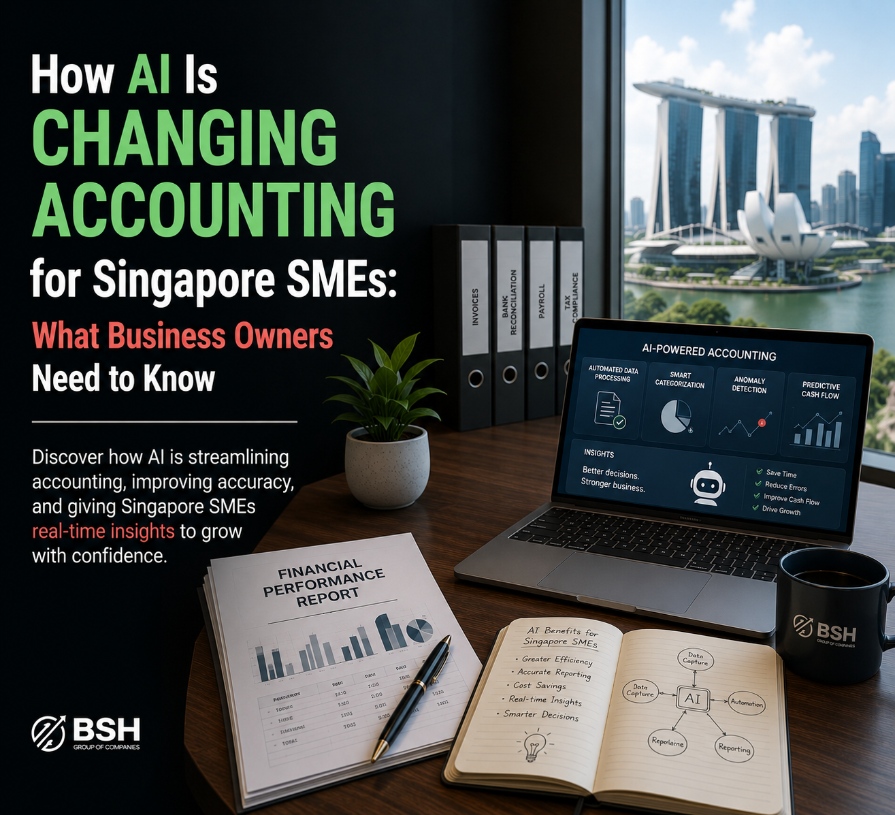
For most Singapore SME owners, accounting has always meant one of two things: spending hours on it yourself or handing it to a professional and hoping the numbers come back correct. Artificial intelligence is changing both sides of that equation — how financial data is captured and processed, and what your accounting firm can do with that data on your behalf.
The change is not hypothetical and it is not coming. It is already here, and it is moving fast. Understanding what is shifting — and what is not — puts you in a much stronger position to make smart decisions about your finances, your service providers, and your own time.
Why AI Is Entering Singapore's Accounting Scene Now
Singapore’s accounting environment has become more demanding at exactly the moment that technology became capable enough to help. IRAS has progressively increased its digital filing requirements. ACRA’s e-filing standards have tightened. GST rules have evolved. CPF contribution calculations have layered in complexity. The volume of compliance work per company has grown, while the talent pipeline for junior accounting staff has remained tight.
The result: accounting firms and finance teams in Singapore have been doing more work with the same or fewer people. AI doesn’t solve every problem in that equation, but it addresses the most time-consuming and error-prone parts — data entry, transaction categorisation, reconciliation, and routine compliance checks — at a speed and consistency no human team can match.
BY THE NUMBERS
More than 70% of Singapore SMEs now use AI-enabled accounting or bookkeeping tools. Manual processing time has dropped by nearly 40% in finance teams that have adopted automation. Accounting firms using AI are handling up to 50% more clients without adding headcount.
For SME owners, the practical impact is already visible in faster turnaround times from accounting firms, more frequent financial reporting, and lower costs for routine bookkeeping. But the shift also creates new questions — about data security, about what your provider is actually doing with AI, and about where human judgment still matters.
What AI Actually Does in Accounting
When people say “AI accounting,” they are usually referring to a combination of machine learning, optical character recognition (OCR), and automation rules applied to financial data. In practice, this means several distinct capabilities working together.
Automated Data Capture
AI can read invoices, receipts, and bank statements — whether scanned, photographed, or uploaded digitally — and extract the relevant data automatically. OCR technology converts the image into structured data. Machine learning models then categorise the transaction, match it to existing records, and flag anything that looks unusual. What used to take a staff member 20 minutes of manual entry takes seconds.
Bank Reconciliation
Reconciling a company’s books against its bank statements is one of the most time-consuming and error-prone tasks in bookkeeping. AI handles this by automatically matching transactions across the bank feed and the ledger, surfacing discrepancies for human review rather than requiring someone to check every line. For high-volume SMEs — retail, food and beverage, e-commerce — this alone can save dozens of hours per month.
Transaction Categorisation
Modern AI accounting platforms learn from historical data to categorise new transactions consistently. If your company always codes office supply purchases to a specific account, the system learns that pattern and applies it automatically. Over time, the categorisation becomes highly accurate, and exceptions are surfaced for review rather than requiring manual processing of every transaction.
Real-Time Reporting
Because AI processes transactions as they occur rather than in batches, financial reports can be generated on demand rather than at month-end. An SME owner can see a current P&L, cash position, or aged receivables report at any point in the month — not just after the accounts have been closed and reviewed by an accountant.
GST and Compliance Automation
For Singapore companies registered for GST, AI platforms can track input and output tax across transactions automatically, prepare draft GST F5 returns, and flag transactions that may be incorrectly classified. This significantly reduces the preparation time for quarterly GST filing and lowers the risk of errors that could trigger IRAS scrutiny.
IMPORTANT DISTINCTION
AI handles data processing and pattern recognition. It does not provide tax advice, make professional judgments about accounting treatment, or take responsibility for the accuracy of your submissions to IRAS or ACRA. Human oversight remains essential.
Key Areas Being Transformed for Singapore SMEs
Bookkeeping
This is where AI has the most immediate impact for SMEs. Routine bookkeeping — recording transactions, categorising expenses, reconciling accounts — is highly repetitive and well-suited to automation. SMEs using AI-enabled bookkeeping services in Singapore are getting more frequent updates, faster month-end closes, and fewer errors, often at a lower cost than fully manual alternatives.
Payroll
AI payroll systems handle CPF calculations, employee claims, and statutory deductions automatically, applying the correct rates and generating the relevant CPF submission files. For SMEs with fluctuating headcount or complex leave and overtime structures, automated payroll significantly reduces the manual workload and the risk of compliance errors.
Accounts Receivable and Payable
AI can monitor outstanding invoices and automatically send payment reminders on a schedule. On the payables side, it can flag invoices due for payment, identify duplicate invoices, and route approvals through digital workflows. For SMEs that struggle with cash flow visibility, this kind of automation provides real-time clarity without requiring a dedicated finance team to manage it.
Tax Preparation
AI platforms can pre-populate corporate tax returns using data already captured in the accounting system, dramatically reducing the manual preparation time. They can also identify deductible expenses that might otherwise be missed and flag transactions that require professional review before filing. The final submission still requires a professional accountant, but the groundwork is done faster and more accurately.
Audit Trail and Compliance Documentation
AI systems create a complete, timestamped audit trail of every transaction and every change made to the accounts. For companies that require audited financial statements — or those that may require them in the future — this documentation makes the audit process significantly more efficient. For corporate secretarial compliance, having clean, AI-maintained records also simplifies annual return preparation and regulatory filings.
AI vs. Traditional Accounting: What's Different
| Area | Traditional Approach | AI-Enabled Approach |
|---|---|---|
|
Data entry |
Manual, batch processing |
Automated, real-time capture |
|
Bank reconciliation |
Manual line-by-line matching |
Automated matching, exceptions flagged |
|
Reporting frequency |
Monthly, after close |
On-demand, any time |
|
GST preparation |
Manual calculation and review |
Auto-categorised, draft return generated |
|
Error detection |
Spotted during review or audit |
Flagged in real time as anomalies |
|
Turnaround time |
Days to weeks for monthly accounts |
Hours to days |
|
Cost structure |
Tied to time and headcount |
Largely fixed, scales with volume |
|
Audit readiness |
Assembled when needed |
Continuous, timestamped trail |
What AI Cannot Replace
AI is very good at processing structured data at scale. It is not good at judgment, context, or professional responsibility. There are several areas where a qualified human accountant remains not just useful but essential.
- Tax advisory — AI can pre-fill a return based on existing data. It cannot advise on restructuring to minimise your tax position, assess the risk profile of an aggressive deduction, or represent you in a dispute with IRAS.
- Financial strategy — Cash flow forecasting, capital structure decisions, expansion planning, and investment analysis require human judgment applied to business context that no algorithm has access to.
- Complex accounting treatments — Revenue recognition under SFRS 15, lease accounting under SFRS 16, and foreign currency transactions often involve judgment calls that AI flags but cannot resolve.
- Professional sign-off — Audited financial statements, compilation reports, and tax filings must be signed off by a qualified professional who takes legal responsibility for the work. AI cannot sign anything.
- Relationship and communication — When a bank asks questions about your accounts, when IRAS issues a query, or when a shareholder wants clarification on the financials, you need a professional who knows your business and can speak to it directly.
THE RIGHT MODEL
The most effective approach for Singapore SMEs is AI doing what it is good at — high-volume, repetitive data processing — with a qualified professional overseeing the output, applying judgment where it is needed, and taking responsibility for the final product. That combination is more accurate and more cost-effective than either approach alone.
How BSH Group Uses Technology to Serve Clients Better
BSH Group has incorporated technology into its accounting and compliance workflows to deliver faster, more accurate service to clients. This means using automated tools for transaction processing and reconciliation while maintaining experienced professional oversight at every stage.
For clients, this translates to more frequent financial reporting, faster turnaround on monthly accounts, lower preparation costs for routine compliance work, and a team that spends its time on the analysis and advice that actually requires human expertise — not on re-keying data from bank statements.
Our approach to professional Bookkeeping Services combines cloud-based accounting platforms with professional review, ensuring that automation speeds up the process without removing the human accountability that compliance work requires. The same principle applies to our tax advisory and corporate secretarial services — technology handles the volume, professionals handle the judgment.
Should Your Business Switch to AI-Powered Accounting?
The honest answer: most Singapore SMEs are already using some form of AI-enabled accounting, whether they realise it or not. The major platforms — Xero, QuickBooks, and others widely used by accounting firms in Singapore — have incorporated AI features into their core workflows. If your accountant is using a modern cloud platform, AI is already part of how your books are being managed.
The more useful question is whether you are getting the full benefit of what technology can offer. Signs that your current setup may be behind:
- You receive financial reports only at month-end or quarter-end, not on demand
- Your accountant takes more than two weeks to close the monthly accounts
- You have limited visibility into cash flow between reporting periods
- GST filing preparation takes several days of back-and-forth
- You are not sure which expenses are being coded to which accounts
- Errors in the books are discovered weeks after they occur
If several of those apply, it is worth having a conversation with your corporate services provider about their current processes and tools. A provider using modern, AI-enabled workflows will be able to give you faster, more accurate reporting at a competitive cost.
If you are looking for an accounting and compliance partner who combines technology with professional expertise, speak to the BSH Group team about what a more efficient setup looks like for your business.


Ready for Smarter Accounting?
BSH Group combines AI-enabled bookkeeping with experienced professional oversight — so your accounts are accurate, current, and compliant without the manual overhead.
Frequently Asked Questions
Is AI accounting safe for Singapore SMEs?
Yes, when implemented correctly. Reputable cloud accounting platforms used in Singapore comply with data protection requirements under the PDPA. The key is ensuring your provider uses platforms with proper access controls, encryption, and audit trails — and that a qualified professional is reviewing the AI’s output rather than relying on it blindly.
Will AI replace my accountant?
No. AI handles the data processing tasks that make up a large portion of routine bookkeeping. It cannot provide tax advice, make professional judgments, sign off on financial statements, or represent your company in regulatory matters. The role of the professional accountant shifts toward oversight, advisory, and strategic input — which are more valuable, not less.
Do I need to change my accounting software to benefit from AI?
Not necessarily. Many accounting firms in Singapore already use AI-enabled platforms such as Xero or QuickBooks, and the AI capabilities are built into the service your provider delivers. You may not need to change software yourself — you just need a provider who is using modern tools effectively.
Can AI handle GST filing in Singapore?
AI can significantly automate the preparation of GST returns — categorising transactions, calculating input and output tax, and generating a draft F5 return. However, the final review and submission must be handled by a qualified professional who takes responsibility for the accuracy of the filing. AI reduces the preparation time, not the professional obligation.
How does AI affect the cost of accounting services in Singapore?
AI reduces the time required for routine bookkeeping tasks, which generally translates to lower fees for those services. However, the cost of professional judgment — tax advice, complex accounting treatments, audit coordination — is unchanged because AI does not perform those tasks. Overall, SMEs using AI-enabled providers tend to get more frequent reporting and faster turnaround at a comparable or lower cost than fully manual alternatives.
Is my financial data secure with AI accounting tools?
The major cloud accounting platforms used in Singapore implement enterprise-grade security including data encryption, role-based access controls, and regular security audits. That said, you should ask your provider which platforms they use, where data is stored, and how access is managed. Any reputable provider should be able to answer these questions clearly.
How do I know if my current accountant is using AI effectively?
Ask them directly: which accounting platform do they use? How frequently can they provide financial reports? How long does it take to close the monthly accounts? What is their process for bank reconciliation? A provider using modern AI-enabled workflows will have clear, fast answers. Vague responses or month-long turnaround times on standard reporting are signs that manual processes are still dominant.
Categories
Latest Posts
- September 29, 2026
How to Register a Company in Singapore Without Relocating: A
- September 20, 2026