
- October 16, 2026

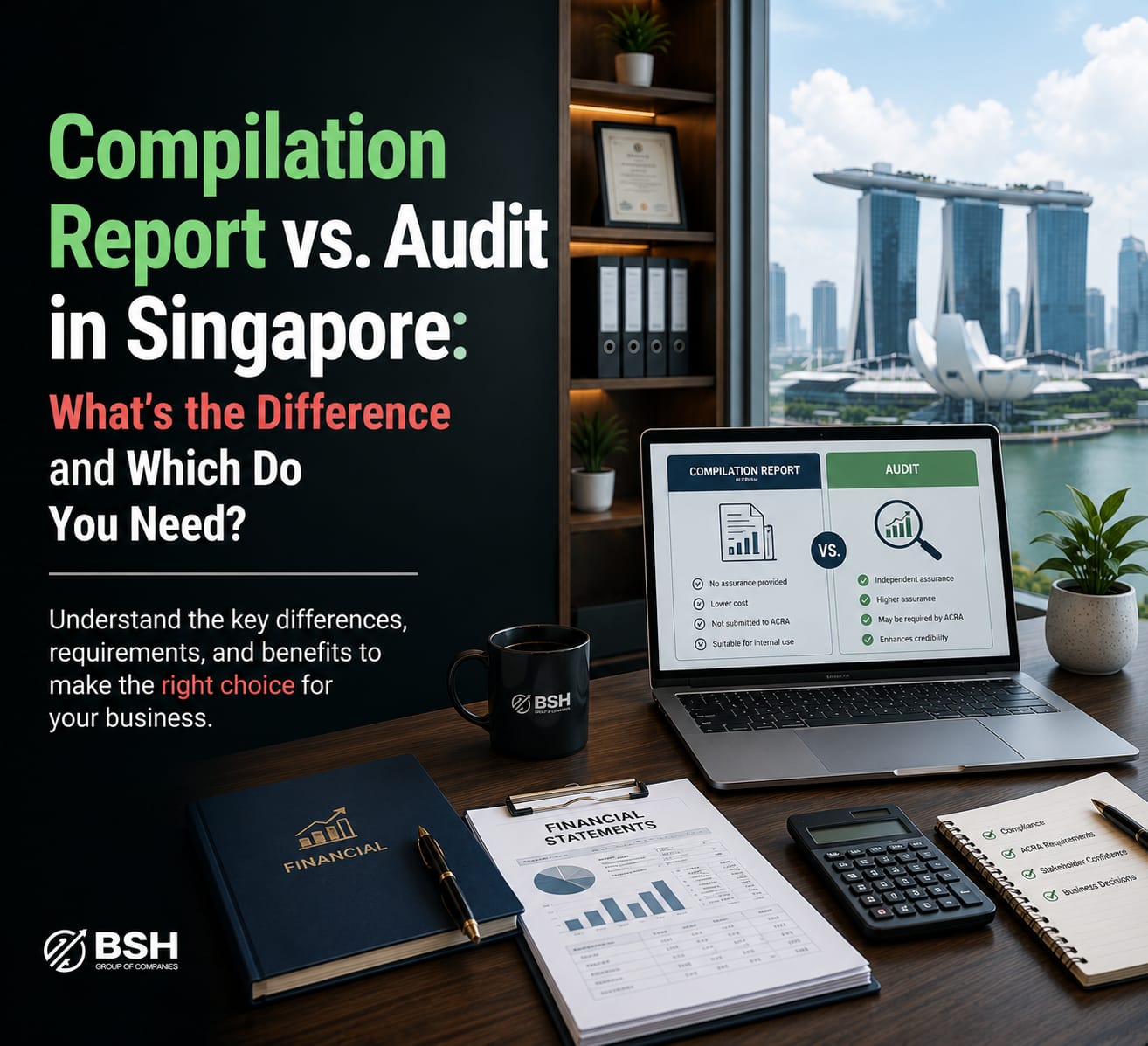
Singapore companies often get asked the same question at year-end: do we need a compilation report or a full statutory audit? The answer depends on your company size, structure, and who’s asking for the financial statements. Get it wrong and you either overpay for an audit you didn’t need or file the wrong report and face ACRA penalties. This guide explains the difference clearly so you can make the right call.
For most Singapore SMEs, the distinction between a compilation report and a statutory audit is not something they think about until the year-end crunch — or until a bank or investor asks for financial statements and they’re not sure what to hand over. Understanding the difference is not just a compliance question. It has direct implications for cost, time, and how credible your accounts appear to third parties.
What Is a Compilation Report?
A compilation report — also referred to as unaudited financial statements in Singapore — is a set of financial statements prepared by an accountant using figures provided by the company. The accountant organises and presents the data in a structured format in accordance with the Singapore Financial Reporting Standards (SFRS), but does not verify, test, or audit any of the underlying numbers.
The compilation report is essentially a cover document that accompanies the financial statements. It states, explicitly, that no assurance of any kind is given on the accuracy or completeness of the information. The accountant is not saying the numbers are right. They are saying: here is what the company gave us, formatted properly.
KEY POINT
A compilation report does not mean the financial statements are wrong. It means they have not been independently verified. The quality of compiled accounts depends entirely on the quality of the underlying bookkeeping.
Companies that qualify for audit exemption under ACRA’s small company framework typically produce compiled financial statements each year. These are filed with ACRA as part of the annual return and submitted to IRAS for tax purposes. They fulfil all statutory filing requirements for an eligible company.
What Is a Statutory Audit?
A statutory audit is a formal, independent examination of a company’s financial statements carried out by a public accountant registered with ACRA. The auditor tests the underlying transactions, verifies balances against supporting documentation, assesses internal controls, and forms an independent opinion on whether the financial statements present a true and fair view of the company’s financial position.
At the end of the process, the auditor issues an audit report expressing one of three opinions: an unqualified opinion (the statements are accurate and compliant), a qualified opinion (with specific exceptions or limitations noted), or an adverse or disclaimer of opinion (where the auditor cannot form a view or the statements are materially misstated).
A statutory audit in Singapore is governed by the Singapore Standards on Auditing (SSA) and must be conducted by a public accountant or accounting firm approved by ACRA. Only auditors who are independent of the company can issue an audit report — the auditor cannot also be the company’s accountant or director.
KEY POINT
An audit provides a formal, independent assurance that the financial statements are reliable. It is a significantly more rigorous and time-consuming process than a compilation, which is why it costs more and takes longer to complete.
Key Differences at a Glance
| Factor | Compilation Report | Statutory Audit |
|---|---|---|
|
Level of assurance |
None — no verification performed |
Reasonable assurance — independent opinion issued |
|
Who prepares it |
Accountant or corporate services firm |
ACRA-registered public accountant (independent)
|
|
Testing of transactions |
No |
Yes — sampling and verification required |
|
Assessment of internal controls |
No |
Yes — included as part of audit scope |
|
Typical cost (Singapore) |
S$500 – S$2,000 per year |
S$2,000 – S$15,000+ per year |
|
Time required |
Days to a few weeks |
Several weeks to months |
|
Accepted by ACRA for filing |
Yes — for audit-exempt companies |
Yes — required for non-exempt companies |
|
Accepted by banks for loans |
Sometimes — for smaller facilities |
Usually required for significant credit |
|
Required for investors / acquirers |
Rarely |
Almost always |
Who Qualifies for Audit Exemption in Singapore?
Under Section 205C of the Companies Act, a Singapore private company qualifies for audit exemption — and may therefore file a compilation report instead of audited accounts — if it meets the small company criteria.
The Small Company Test
A company qualifies as a small company if it satisfies at least 2 of the following 3 criteria for the immediately preceding two consecutive financial years:
- Total annual revenue below S$10 million
- Total assets below S$10 million
- Number of full-time employees fewer than 50
NEW COMPANIES
For companies in their first or second financial year, the two-consecutive-year test cannot yet apply. ACRA’s position is that newly incorporated companies assess eligibility based on their current financial year figures until the two-year lookback becomes available.
The Small Group Test
If your company is part of a group — meaning it has a parent company or owns subsidiaries — audit exemption is only available if the individual company qualifies as a small company AND the group as a whole also qualifies as a small group. The small group test applies the same 2-of-3 criteria to the group’s consolidated figures. A Singapore subsidiary of a large foreign parent company will generally not qualify even if the subsidiary itself is small.
Dormant Companies
Under Section 205B of the Companies Act, dormant companies are exempt from audit under a separate pathway. A company is considered dormant if it has had no accounting transactions during the financial year, with limited exceptions such as ACRA filing fees and share issuance at incorporation.
IMPORTANT
Audit exemption does not mean a company has no compliance obligations. Exempt companies must still prepare financial statements, file an annual return with ACRA, and submit tax returns to IRAS. Only the external audit requirement is removed.
Which One Does Your Company Actually Need?
The practical answer depends on two things: what the law requires, and what your stakeholders expect.
QUICK DECISION GUIDE
| You likely need a Compilation Report if: | You likely need a Statutory Audit if: |
|---|---|
|
You meet 2 of 3 small company criteria |
Revenue, assets, or headcount exceed the thresholds |
|
You are not part of a large group structure |
You are a subsidiary of a non-qualifying parent company |
|
No bank, investor, or third party is requesting audited accounts |
A bank requires audited accounts for a loan or facility |
|
Your company is newly incorporated and below the thresholds |
An investor, acquirer, or JV partner requires it
|
|
Your company is dormant with no transactions |
Shareholders holding 5%+ of shares request an audit |
|
|
You are applying for certain government grants or tenders |
One point that catches many directors off guard: even if a company legally qualifies for audit exemption, shareholders holding 5% or more of the issued shares can request a statutory audit under Section 205C(5) of the Companies Act. The company is obligated to comply with such a request if made within the relevant window.
What Banks and Investors Expect
Legal eligibility for audit exemption and practical acceptability to third parties are two different things. This is where many SMEs get caught.
Most Singapore banks will accept compiled financial statements for trade financing, small overdraft facilities, or preliminary credit assessments. For term loans, project financing, or new banking relationships where the credit line is material, banks will typically require at least two years of audited financial statements regardless of the company’s audit exemption status.
Investors and acquirers are even more consistent on this point. Any serious due diligence process will require audited accounts. A compiled report tells a potential investor that the numbers have not been independently verified — which is not a position most investors are comfortable with, particularly for growth-stage or acquisition targets where the valuation hinges on the accuracy of the financials.
The practical takeaway: if you are planning to raise capital, sell the business, or enter a significant banking relationship in the next 12 to 24 months, it is worth considering a voluntary audit even if you currently qualify for exemption. Retroactively auditing prior years is possible but slow, expensive, and disruptive. Getting ahead of the requirement is almost always more efficient.
Cost Comparison
| Company Type | Compilation Report (approx.) | Statutory Audit (approx.) |
|---|---|---|
|
Sole director, minimal transactions |
S$500 – S$800 |
S$2,000 – S$4,000 |
|
Active SME, revenue under S$1M |
S$800 – S$1,500 |
S$3,000 – S$6,000 |
|
Growing SME, revenue S$1M – S$5M |
S$1,500 – S$2,500 |
S$5,000 – S$10,000 |
|
Mid-size, revenue S$5M – S$10M |
S$2,000 – S$3,500 |
S$8,000 – S$15,000+ |
These are approximate ranges. Actual fees depend on the volume and complexity of transactions, whether payroll is included, and whether prior-year accounts need to be restated or cleaned up. Companies with messy bookkeeping typically pay more regardless of which type of report they need.
The most cost-effective approach is maintaining clean, well-organised books throughout the year. Quality bookkeeping services in Singapore reduce the preparation time for both compilation reports and audits, which directly reduces the professional fees. A company with current, reconciled accounts will always pay less than one that hands over a box of receipts at year-end.
BSH Group prepares compilation reports and handles annual ACRA filings for Singapore companies at every stage. If you are unsure whether your company qualifies for audit exemption or which type of report fits your situation, speak to the team for a straightforward assessment.


Not Sure Which Report Your Company Needs?
BSH Group's accounting and compliance team will assess your eligibility and handle your financial statements from start to finish — compilation, audit coordination, and ACRA filing included.
Frequently Asked Questions
What is a compilation report in Singapore?
A compilation report in Singapore is a set of financial statements prepared by an accountant using figures provided by the company, without any verification, testing, or assurance on their accuracy. It is typically used by companies that qualify for audit exemption under ACRA’s small company framework. The report states clearly that no assurance of any kind is given on the numbers presented.
Who qualifies for audit exemption in Singapore?
A Singapore private company qualifies for audit exemption if it meets at least 2 of 3 criteria for the past two consecutive financial years: total annual revenue below S$10 million, total assets below S$10 million, and fewer than 50 full-time employees. Companies that are part of a group must also satisfy the small group test on consolidated figures.
Is a compilation report the same as unaudited financial statements?
Yes, in the Singapore context these terms are used interchangeably. A compilation report is the accountant’s cover letter accompanying unaudited financial statements, stating that no assurance is given on the accuracy or completeness of the figures presented. Both refer to the same type of financial reporting engagement.
Can a bank accept a compilation report instead of an audit?
It depends on the bank and the type of facility. For smaller credit lines or trade facilities, some Singapore banks accept compiled accounts. For larger loans, project financing, or new banking relationships, banks typically require audited financial statements regardless of whether audit exemption applies. Check with your relationship manager before assuming compiled accounts will suffice.
Does audit exemption mean a company does not need to file financial statements?
No. Audit exemption only removes the obligation to have the accounts audited by an external auditor. The company must still prepare financial statements in accordance with SFRS, file an annual return with ACRA within 7 months of the financial year-end, and submit corporate tax returns to IRAS on the usual schedule.
How much does a compilation report cost in Singapore?
Compilation report fees in Singapore typically range from S$500 to S$2,500 per year depending on the volume of transactions and the complexity of the accounts. This is significantly lower than a statutory audit, which can cost between S$2,000 and S$15,000 or more. The quality and organisation of your bookkeeping records is the biggest variable in either case.
What happens if a company files the wrong type of report?
Filing unaudited accounts when a statutory audit is required is a breach of the Companies Act. ACRA may issue a notice requiring the company to appoint an auditor and resubmit compliant financial statements. Directors can be held personally liable for non-compliance. If you are unsure which applies to your company, a qualified corporate services provider can assess your eligibility before year-end.
Categories
Latest Posts
- September 29, 2026
How to Register a Company in Singapore Without Relocating: A
- September 20, 2026